Monday, July 23, 2007

Above the Arctic Circle

Joe Decker is a nature photographer of extraordinary gifts. The range of his work is astonishing -- from precise yet delicate flower studies to almost abstract images of moving light on moving water, from dramatic high-contrast pictures to tone-on-tone images that could almost be silkscreen prints.

I love the grand, painterly vistas, but then I'm a sucker for mountainsides. Also for the light on the leaves.

His most recent work was shot in Greenland and Iceland, whose stark landscapes lend themselves well to his vision of abstract shapes in the natural world. An almost Mondrian panorama speckled with migrating birds. The rippled clouds and rippled hillside of a fjord. A glacier's ice ridges like pastel corduroy and the netted reflections of ocean on iceberg.

If you're in the area, come out and see these pictures. Wherever you live, buy some. I own a Joe Decker photograph, and the image is more beautiful every time I look at it.

Opening Reception for "Above the Arctic Circle", Friday, July 27, 6-8 pm

Opening reception. Pacific Art League, 668 Ramona, Palo Alto, California.

This is the reception for the first large-scale, major show I've done in well over a year, and will feature approximately 30 previously undisplayed works from my travels through Svalbard and East Greenland. If you can attend only one show of mine this year, make it this one.

Tuesday, July 17, 2007

All the Way Home

I left work tonight after sunset and drove westward toward the Santa Cruz Mountains instead of east toward my apartment. It had been a long, rough day, but there was something I wanted even more than to get home and fall into bed.

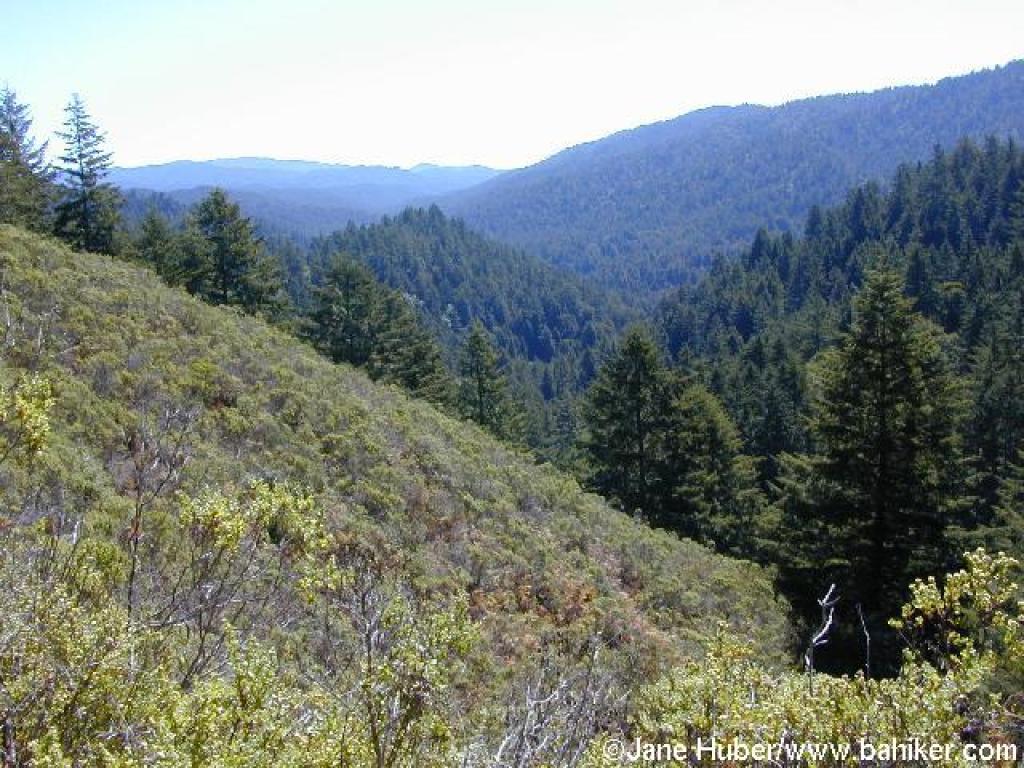
As I crossed the San Andreas fault, I came into the country of lion-colored hills crowned with oaks. As twilight deepened, I drove north along 280, sometimes called the most beautiful freeway in the world. The mountains to the west were dark as slate, and the frothy dark clouds of the marine layer were surging over them. Above, in the clear sapphire sky, hung the crescent moon and the evening star.

I kept my windows open to the night air, fragrant with grass and leaves and earth, and I watched the long ridges, almost lightless, running between the highway and the sea.

If I drove up one of the steep, tortuous roads and into the mountains, I would find rolling meadows with clefts concealed by scrub. Then, as I went higher, higher, the Trappist dignity of the redwood groves. The towering sequoias always seem both aware of visitors and heedless of them. Their size and age give them a natural authority. Their presence is restful -- a day in the redwoods is a spiritual retreat.

But tonight I needed to get home, I couldn't drive the labyrinthine roads into the woods, or walk silently through the darkness. Just passing by, though, was enough, almost enough.

Sometimes my family back east asks how I can stand to live in the urban sprawl of the Silicon Valley megalopolis. But there's scarcely a spot here where you can't look up and see the wild hills.

Six years ago, I got on a plane with a suitcase, a laptop, and a yowling cat and flew 3000 miles to San Jose. Moving to the Bay Area made enormous changes to my life. Here I've found more new friends and love and natural beauty than I thought my heart could hold. And I found home.

Sunday, July 15, 2007

BASEBALL: Phillies Set a New Record

My boys have reached a landmark achievement in sports: A myriad lost games. Ten thousand failures.

A toast to the most futile professional sports franchise ever. Not just the most futile baseball team. No football team (US or European rules), no basketball team, no hockey team has set a record of such consistent failure. For more than a hundred years the Phillies have been losers.

Now, as the motivational speakers say, it doesn't matter how often you fail. What matters is how often you succeed!

Well, yeah, but baseball is a zero-sum game.

I'd like to point out that the boys are a game over .500, and although they lost the game today to the Cardinals, they creamed the Cardinals in the previous two games.

Tuesday, July 03, 2007

Disgruntled Thought of the Day

Occam's Razor: Entities should not be multiplied beyond necessity.

Sometimes summarized as "the simplest explanation is the best."

Occam's Other Razor: Never attribute to malice what you can attribute to stupidity.

Note: "Stupidity" here has nothing to do with IQ, everything to do with haste, distraction, innocent mistakes, cluelessness, poor planning, incompetence, and the many other ways people and organizations screw up.

This is a wise guide to life most of the time. Very few people go through life deciding to wreak havoc for the thrill of it. Mostly they just want to get through the day undamaged.

Occam's Razor Strop: When stupidity stops being an occasional accident and becomes corporate policy, cover your ass.

Stupidity, when indulged, can be even more destructive than willed evil. Evil is at least usually organized. Who the hell needs malice when you have poor planning, bad management, and ridiculous decisions? When these have become the trademark of an individual, company, or presidency, stupidity has reached critical mass. Try not to be there when it blows up.

Friday, June 29, 2007

Animal Husbandry for Sociopaths

We've all heard about Mitt Romney's carefully planned strategy for taking his dog on a 12-hour highway drive in the punishing sun and heat of summertime.

Before beginning the drive, Mitt Romney put Seamus, the family's hulking Irish setter, in a dog carrier and attached it to the station wagon's roof rack. He'd built a windshield for the carrier, to make the ride more comfortable for the dog.[snip]

As the oldest son, Tagg Romney commandeered the way-back of the wagon, keeping his eyes fixed out the rear window, where he glimpsed the first sign of trouble. ''Dad!'' he yelled. ''Gross!'' A brown liquid was dripping down the back window, payback from an Irish setter who'd been riding on the roof in the wind for hours.

As the rest of the boys joined in the howls of disgust, Romney coolly pulled off the highway and into a service station. There, he borrowed a hose, washed down Seamus and the car, then hopped back onto the highway. It was a tiny preview of a trait he would grow famous for in business: emotion-free crisis management.


I think we should jam old Mitt naked into a carrier in the same conditions and take the same roadtrip. With a camera to broadcast his distress.

Deliberately abusing animals does not, I repeat NOT, make you a cool, unemotional decision-maker. It makes you a vicious jerk, and it's good evidence that you're a sociopath. Mitt Romney joins Dr. James Dobson in my gallery of dangerous religious-right power-seekers.

What did Dobson do that was so dreadful? Let's just say he over-reacted when his dog didn't go to bed on command:

I had seen this defiant mood before, and knew there was only one way to deal with it. The ONLY way to make Siggie obey is to threaten him with destruction. Nothing else works. I turned and went to my closet and got a small belt to help me "reason" with Mr. Freud.

What developed next is impossible to describe. That tiny dog and I had the most vicious fight ever staged between man and beast. I fought him up one wall and down the other, with both of us scratching and clawing and growling and swinging the belt. I am embarrassed by the memory of the entire scene. Inch by inch I moved him toward the family room and his bed. As a final desperate maneuver, Siggie backed into the corner for one last snarling stand. I eventually got him to bed, only because I outweighed him 200 to 12!


He takes that approach to child-rearing, too, except he thinks that kids need to be treated with even greater severity than small dogs.

One proof of intelligent design is that Dobson and Romney, similar as they are, are nevertheless not cooperating on this election. As Amy Sullivan explains, Christian Fundamentalists regard Romney's Mormon faith as a dangerous cult. Long may their intolerance last.

Friday, June 08, 2007

The Dying Gaul, Explained

Thursday, June 07, 2007

I Confess

I have fallen prey to the cat macro fad.


I've forgotten where I got this picture; caption and Photoshop all mine.


Since I got back from WisCon, I've been trying to catch up with work, sleep, life . . . all of which has left me wiped out enough that I spent several hours this weekend looking at cat macros.


Alan Bostick provided the caption. Lavendertook provided the cat and photo.


Lolbots.

Lolpresidents.

Lolpoker and Lolcasinos are for sale. Just in time for the WSOP!

Loltheorists.

Theolologians.

Philolsophers.

More philolsophers.

Lolgeeks.

Lolhistory. Including a LolSuffragist.

Lolgays. Not actually funny.

Lolcode.

And Laughing Squid with a few I missed.

The immorally funny self-macroing cats. Includes Craigslist personals!

And here's Jimmy Hoffa, Lolteamster.

Tuesday, May 15, 2007

Good Night, Reverend Falwell

Isaiah, chapter 40

1 Comfort ye, comfort ye my people, saith your God.
2 Speak ye comfortably to Jerusalem, and cry unto her, that her warfare is accomplished, that her iniquity is pardoned: for she hath received of the LORD's hand double for all her sins.
3 ¶ The voice of him that crieth in the wilderness, Prepare ye the way of the LORD, make straight in the desert a highway for our God.
4 Every valley shall be exalted, and every mountain and hill shall be made low: and the crooked shall be made straight, and the rough places plain:
5 and the glory of the LORD shall be revealed, and all flesh shall see it together: for the mouth of the LORD hath spoken it.
6 ¶ The voice said, Cry. And he said, What shall I cry? All flesh is grass, and all the goodliness thereof is as the flower of the field:
7 the grass withereth, the flower fadeth; because the spirit of the LORD bloweth upon it: surely the people is grass.
8 The grass withereth, the flower fadeth: but the word of our God shall stand for ever.
9 ¶ O Zion, that bringest good tidings, get thee up into the high mountain; O Jerusalem, that bringest good tidings, lift up thy voice with strength; lift it up, be not afraid; say unto the cities of Judah, Behold your God!
10 Behold, the Lord GOD will come with strong hand, and his arm shall rule for him: behold, his reward is with him, and his work before him.
11 He shall feed his flock like a shepherd: he shall gather the lambs with his arm, and carry them in his bosom, and shall gently lead those that are with young.

Wednesday, April 25, 2007

POLITICS: From Her Lips to God's Ear

Laura Bush made an announcement this morning on the Today Show: "No one suffers more than their President and I do."

No one? Not the kids whose parents have been killed, or the parents whose children have been killed or maimed? Not the double amputee vet shaking from nightmares in a rat-infested VA hospital room? Not the Iraqis whose homes, lives, and country have been crushed into bleeding fragments?

Remember, this is the draft-dodging frat boy who has taken more vacation days than Ronald Reagan -- who has, in fact, spent more than a year of his Presidency on vacation.

Has he even missed a meal?

Thanks to Alan Bostick of As I Please for the link.

Tuesday, April 10, 2007

REVIEW: All the Songs of Heroes

Disclaimers: Unlike many of my readers, I did not know the late John Milo “Mike” Ford. I first encountered his work in Neil Gaiman’s blog and in his inimitable contributions to Making Light. If he ever posted to any of the Usenet groups I used to frequent, it’s so long ago that I don’t recall it.

When, several years ago, I picked up The Dragon Waiting, I didn’t even realize that the John M. Ford was the Mike Ford who was so often mentioned by my friends in fandom, nor that he was Elise’s “dear Mr. Ford.” The book looked interesting, and it was on the fiction shelves of Alan and Debbie—a sure guarantee of literary quality.

I devoured it—gulped it down, and read as much of his work as I could find in the succeeding weeks. It was subtle, brilliant, complex, and humane. I wished I could meet an author capable of writing such a dazzling novel in his mid-twenties. Our one chance was spoiled when he broke his foot just before he and Elise were to meet Alan and me in Las Vegas.

Literary criticism can be a touchy business, especially when the late author is widely known and loved. But criticism is the wrong word here; I’ll leave that to Derrida and nagging parents. Call it literary commentary. Worse, this commentary is not even a broad survey by an expert in the field or a definitive summing-up of a career. It’s a brief look at a single facet of a highly complex oeuvre. Death in the work of Mike Ford.

Mike Ford died young, and he spent four-fifths of his life dealing with chronic illness. From age 11 on, he had severe Type I diabetes. Eventually it wrecked his kidneys; a transplant gave him six extra years of life. Many of the people who knew and loved him say he lived a good ten years beyond what he expected, and they all credit his longterm partner Elise for saving his life. (alanbostick also says his writing was just the icing on the cake—that knowing him was even more rewarding than reading him.) Mike would have been fifty years old today.

I returned to Mike Ford’s work because I’ve been trying to whip up a certain rage at encroaching death. If I could feel it on his behalf, maybe I could learn to feel it for myself. Things did not work out that way. I found something infinitely more precious and joyful there.


WARNING: spoilers for The Dragon Waiting, How Much for Just the Planet?, Heat of Fusion and Other Stories

The Dragon Waiting, a subtle, brilliant alternate history, offers a plausible solution to the mystery of the Princes in the Tower. The divergences from history start with the existence of vampires. Instead of dying young, the Emperor Julian the Apostate became a vampire and survived long enough to bring back paganism, which resulted in a cascade of changes: Christianity is a minority religion, and Byzantium still rules most of Europe.

All vampire stories play with death. Ford’s play is both explicit and implicit.Explicitly, his vampires are individuals confronting the ugly realities: some gladly surrender their humanity and revel in bloodlust; others build relationships where occasional blood feeding is a gift for the family vampire, who otherwise subsists on animal blood alone; others confine themselves to animals and perhaps dying soldiers on a battlefield. One spends much of the book close to suicide; he keeps facing the terror of living (almost) forever. Incidentally, the vampire subplots are blessedly free from morbid romanticism; Ford’s chief vampire is an engineer.

The implicit playing with death is more subtle and almost lost in the conventions of alternate history. But Mike Ford not only works through the changes of history that his hypothetical situation entails, he also grants Anthony Woodville, Earl Rivers, a life that does not end on the scaffold—and the kind of lover he deserved. Rivers, a scholar and parfit gentle knight, may have been the only sympathetic Woodville. He was certainly the most literate of them.

The textual complexities of The Dragon Waiting are not an adequate preparation for How Much for Just the Planet? Nothing short of a PhD in popular culture and a large canister of nitrous oxide could possibly prepare the reader for this book. Try to imagine a Star Trek novel that starts with an inflatable rubber spaceship. Or one that combines the French farce of Georges Feydeau and the hometown nostalgia of Ray Bradbury. Or one that simultaneously riffs off Shakespeare, Gilbert and Sullivan, The Maltese Falcon, and half a dozen other cultural icons. Or one that finishes, as Dr. Strangelove was supposed to, with a cream-pie fight and the end of the world as we know it.

Now try to think of them all at once.

That’s the magnificently silly gift Mike Ford gave us in How Much for Just the Planet? I can’t compare it to any other Star Trek novel, because I’ve never read any other Star Trek novels. If they’re all this good, I have to catch up on some reading. But I doubt it. Very few writers of any genre are as skilled, inventive, playful, and profoundly humane as the author of this romp.

Also smart. He must have had a mind crammed with trivia and a library full of obscure and fascinating books and movies. Even as I laughed over allusions to “Peppermint Soda” and “Animal House,” I knew I must be missing a dozen allusions to every one I got—an experience positively Silverlockian. Clearly he was having fun: several well-known SF authors appear as characters, and he plays endlessly with the conventions of the genre.

How Much for Just the Planet? is a relatively early book, but its splendid foolery contains a key to the rest of the novelist and poet’s work. The settlers of a small, beautiful planet have made the place home, despite being there only one generation. Unfortunately, their planet has enormous dilithium reserves, which the Klingons and the Federation both need. And so our hero plots his roaring farce, recruits almost everyone else on the planet to participate in Plan C, and plays ringmaster to the comedy that greets the inevitable invasion of dilithium seekers.

He knew the life he loved couldn’t last. So he greeted the end of that life with a pie in the face.


The stories and poems in Heat of Fusion and Other Stories deal variously with death. In the title story, a scientist in a post-apocalyptic world is dying of radiation poisoning. The government urges him to write down his notes on the fusion experiments to create a new bomb, but he has arranged that any successful fusion will destroy the lab and everyone near it—including himself. His last words are “light. triumph”—an extraordinary greeting for death.

“Shelter from the Storm” returns to themes and tropes familiar from How Much for Just the Planet? A small planet, caught at a moment of vulnerability, must defend itself against attack by overwhelming forces. It’s classic hard SF, but it’s also a nuanced, tender love song to a home, a long life, a marriage, and a family Ford knew he would never live to have. The protagonist, Marshall Kinbote, is married to a calm and beautiful woman. “I would have been dead without Elise thirty years ago. Even if my body continued to breathe, I would have been dead.”

Knowing they cannot win in straightforward battle, Kinbote discovers that his daughter’s fiancé has been trained in a kind of guerrilla warfare: carefully targeted sabotage that so disrupts the plans of the attacking enemy that they must give up the attempt. The fiancé explains that he has been shaped into something like a werewolf—and warns the daughter that only someone who loves the werewolf can ultimately slay him.

“Dateline: Colonus” brings Oedipus to small-town America, where he and his daughters stop at a roadside café run by the Kindly Ones, Theseus is sheriff, and the self-blinded old man is able to end his life in peace, leaving great blessings for the place where he dies.

“Dark Sea,” one of the long poems in Heat of Fusion, sends an ancient Greek poet into space with modern Stellar-Namers and Readers of Earth. And in that poem, Ford states his lifelong theme clearly—though with characteristic doubleness. “All the songs of heroes are songs of Death.” All the songs sung by heroes, all the songs sung about heroes. “We sing because we die; the song goes on.”

Mike Ford was a hero. All his life he saw the dragon waiting, and he teased it, played with it, danced with it, told it stories, and pulled rabbits out of hats to entertain it. When he finally mounted it and rode away, he was kind enough to leave us some poems and stories to amuse us while we wait our turn.